Tesserva Continuity / Evaluation data for AI agents

Evidence changes.
Can your agent keep up?

Original tasks built from reusable sources. Test whether an agent can repair its analysis, preserve valid work, and keep its files consistent.

01 / A prior workspace

Work already delivered.

A source, an analysis and the files an agent needs to maintain.

02 / New evidence

Something changes.

A correction, revision or failed step affects part of that work.

03 / Checked outcomes

Repair what matters.

Update affected outputs. Preserve valid results. Check the final files.

Our recommended scope

Six data families.
One worked example of each.

Tables, documents, web evidence, charts, records and tool workflows. Each becomes a task with a prior state, a change, a reference outcome and explicit checks.

01 / CSV · XLSX · JSON

Withdraw one unreliable figure.

A source warning changes what can be concluded, even when the downloaded numbers have not changed.

Real public source · reconstructed task

Starting evidence

July counts: applications 3,853; vouchers issued 3,057; redemption applications 2,723; redemptions paid 3,025. A prior decision says the invented 3,000-voucher target was met.

What changes

The publisher warns of an administrative error affecting issued vouchers in M1.1 and selected other tables. The other three measures are unaffected. No confirmed replacement is supplied.

The agent's task

Using only this frozen extract and notice, repair report.json, chart_data.json and decision.json. Withhold an affected unresolved value as null; preserve unaffected values and the July period. Do not use a planned correction date as proof of resolution or treat distinct monthly flows as a conversion cohort.

Reference outcome

Withhold vouchers issued and the target decision. Keep all three unaffected counts. Flag source follow-up and update every dependent output.

What the checks assess

  • Only vouchers_issued becomes null.
  • The three unaffected counts and July period are preserved.
  • The target conclusion is null, with source follow-up required.
  • Report and chart data agree.
Download this worked example
Inspect prior and reference outputs
Prior outputs
{
  "report.json": {
    "period": "2025-07",
    "counts": {
      "applications_received": 3853,
      "vouchers_issued": 3057,
      "redemption_applications_received": 2723,
      "redemptions_paid": 3025
    }
  },
  "chart_data.json": {
    "period": "2025-07",
    "values": {
      "applications_received": 3853,
      "vouchers_issued": 3057,
      "redemption_applications_received": 2723,
      "redemptions_paid": 3025
    }
  },
  "decision.json": {
    "period": "2025-07",
    "issued_target": 3000,
    "target_met": true,
    "source_follow_up_required": false
  }
}
Reference outputs
{
  "report.json": {
    "period": "2025-07",
    "counts": {
      "applications_received": 3853,
      "vouchers_issued": null,
      "redemption_applications_received": 2723,
      "redemptions_paid": 3025
    }
  },
  "chart_data.json": {
    "period": "2025-07",
    "values": {
      "applications_received": 3853,
      "vouchers_issued": null,
      "redemption_applications_received": 2723,
      "redemptions_paid": 3025
    }
  },
  "decision.json": {
    "period": "2025-07",
    "issued_target": 3000,
    "target_met": null,
    "source_follow_up_required": true
  }
}

Source record. DESNZ Boiler Upgrade Scheme, July 2025, monthly table M1.1 (source Ofgem). Four aggregate values extracted from the current download; the prior analysis and target are original constructions. This is not a certified historical replay.

Department for Energy Security and Net Zero, Boiler Upgrade Scheme statistics, source: Ofgem. Contains public sector information licensed under the Open Government Licence v3.0.
02 / PDF · text · Markdown

Apply the revision to the right scope.

A document changes one rule. The agent must repair the affected guidance while preserving the exception.

Constructed scenario

Starting evidence

Aster Archive policy v1: Standard files are retained for 30 days. Premium files are retained for 90 days. The help guide currently repeats those rules.

What changes

Policy v2 takes effect on 15 September 2026. Standard retention falls to 14 days for uploads on or after that date. Earlier Standard uploads keep 30 days; Premium stays at 90 days.

The agent's task

Repair guide.json and upload_rules.json for three supplied uploads. Use each upload's tier and date. Preserve the Premium exception and the grandfathered Standard rule.

Reference outcome

An old Standard upload keeps 30 days, a new Standard upload gets 14 days, and a Premium upload keeps 90 days. The guide explains all three scopes.

What the checks assess

  • The effective date is applied to uploads, not the review date.
  • The older Standard upload remains at 30 days.
  • The newer Standard upload changes to 14 days.
  • Premium remains at 90 days in both files.
Download this worked example
Inspect prior and reference outputs
Prior outputs
{
  "guide.json": {
    "version": "v1",
    "standard_days": 30,
    "premium_days": 90
  },
  "upload_rules.json": {
    "old-standard": 30,
    "new-standard": 30,
    "premium": 90
  }
}
Reference outputs
{
  "guide.json": {
    "version": "v2",
    "standard_before_2026_09_15_days": 30,
    "standard_from_2026_09_15_days": 14,
    "premium_days": 90
  },
  "upload_rules.json": {
    "old-standard": 30,
    "new-standard": 14,
    "premium": 90
  }
}

Source record. An original fictional service policy, not a real provider's terms or legal advice. Text excerpts stand in for the same content in a document or PDF.

Original Tesserva demonstration. All service names, policy terms and values are invented.

03 / HTML · text · source metadata

Choose evidence over the newest copy.

Several pages repeat a date. A newer secondary page still carries the older claim.

Constructed scenario

Starting evidence

A cached Aster Observatory FAQ says winter bookings open on 5 November. A planning note uses that date and a 30-minute visit duration.

What changes

The official booking announcement, updated on 15 September, moves opening to 12 November. A travel blog dated 20 September still repeats 5 November. The visit duration is unchanged.

The agent's task

Repair plan.json using the declared source policy: the current official booking announcement governs booking dates; copied secondary pages do not override it merely because they are newer. Preserve the visit duration and record the supporting source ID.

Reference outcome

Use 12 November, cite official-booking-v2, preserve the 30-minute duration, and record that the old date was superseded.

What the checks assess

  • The date comes from the current primary announcement.
  • A newer secondary timestamp does not override authority.
  • The source identifier is recorded.
  • The unaffected visit duration is preserved.
Download this worked example
Inspect prior and reference outputs
Prior outputs
{
  "plan.json": {
    "booking_opens": "2026-11-05",
    "visit_minutes": 30,
    "source_id": "cached-faq-v1",
    "old_date_superseded": false
  }
}
Reference outputs
{
  "plan.json": {
    "booking_opens": "2026-11-12",
    "visit_minutes": 30,
    "source_id": "official-booking-v2",
    "old_date_superseded": true
  }
}

Source record. Original fictional page extracts and source identifiers. No actual observatory, copied website or live reservation service is represented.

Original Tesserva demonstration. The organization, extracts and dates are invented.

04 / SVG · chart data · report JSON

Make the picture match the calculation.

A corrected table turns an apparent rise into a decline. The chart and decision must change together.

Constructed scenario

Starting evidence

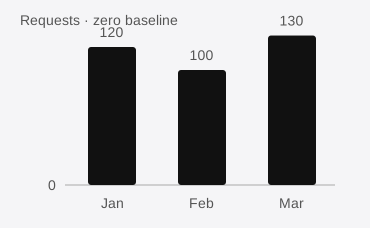
A report shows requests of 120 in January, 100 in February and 130 in March. Its chart and summary show an 8.3% January-to-March rise.

What changes

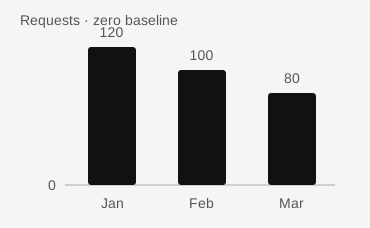
An approved correction replaces March's value with 80. January and February are unchanged. A task-specific rule requires follow-up when the latest month is below 90.

The agent's task

Repair chart_data.json, summary.json and decision.json. Calculate the January-to-March percentage change as (March − January) / January × 100, rounded to one decimal place. Keep a zero baseline in the displayed bar chart.

Reference outcome

The March bar falls to 80. The report shows a 33.3% decline and the follow-up decision becomes true.

What the checks assess

  • March changes from 130 to 80; January and February remain fixed.
  • The percentage change is −33.3%, rounded to one decimal.
  • The chart data and summary use the same corrected values.
  • The below-90 follow-up rule is applied.
Download this worked example
Before correction: January 120, February 100, March 130 requests
Before / +8.3%
After correction: January 120, February 100, March 80 requests
After / −33.3%
Inspect prior and reference outputs
Prior outputs
{
  "chart_data.json": {
    "months": [
      "Jan",
      "Feb",
      "Mar"
    ],
    "requests": [
      120,
      100,
      130
    ],
    "baseline": 0
  },
  "summary.json": {
    "jan_to_mar_percent": 8.3,
    "direction": "increase"
  },
  "decision.json": {
    "latest_requests": 130,
    "follow_up": false
  }
}
Reference outputs
{
  "chart_data.json": {
    "months": [
      "Jan",
      "Feb",
      "Mar"
    ],
    "requests": [
      120,
      100,
      80
    ],
    "baseline": 0
  },
  "summary.json": {
    "jan_to_mar_percent": -33.3,
    "direction": "decrease"
  },
  "decision.json": {
    "latest_requests": 80,
    "follow_up": true
  }
}

Source record. Invented monthly request counts and an original SVG chart. This demonstration checks chart data and numerical conclusions; it does not establish general image understanding.

Original Tesserva demonstration. All request counts and thresholds are invented.

05 / JSON · CSV · stable IDs

Separate duplicates, revisions and unknowns.

An incoming batch repeats one record, revises another and leaves a quantity unknown.

Constructed scenario

Starting evidence

A101: 5 units at $12. A102: unknown units at $10. A103: 2 units at $15. The known subtotal is $90; one record is unresolved.

What changes

The batch repeats A101 at revision 1 and supplies A103 revision 2 with 3 units. A102 is still unknown. The rules say to deduplicate identical ID/revision pairs and use the highest approved revision per ID.

The agent's task

Repair records.json and totals.json. Keep one row per stable ID, retain null for unknown units, apply the approved revision, and calculate only the known subtotal. Sort records by ID for the declared output contract.

Reference outcome

Three records remain. A103 changes to 3 units, A101 is counted once, and A102 stays unknown. The known subtotal is $105, with one unresolved record.

What the checks assess

  • The duplicate does not create a fourth row or another charge.
  • A103 revision 2 replaces revision 1.
  • Unknown units remain null, rather than becoming zero.
  • The known subtotal is $105 and unresolved_records is 1.
Download this worked example
Inspect prior and reference outputs
Prior outputs
{
  "records.json": [
    {
      "id": "A101",
      "revision": 1,
      "units": 5,
      "unit_price_usd": 12
    },
    {
      "id": "A102",
      "revision": 1,
      "units": null,
      "unit_price_usd": 10
    },
    {
      "id": "A103",
      "revision": 1,
      "units": 2,
      "unit_price_usd": 15
    }
  ],
  "totals.json": {
    "known_subtotal_usd": 90,
    "unresolved_records": 1,
    "unique_records": 3
  }
}
Reference outputs
{
  "records.json": [
    {
      "id": "A101",
      "revision": 1,
      "units": 5,
      "unit_price_usd": 12
    },
    {
      "id": "A102",
      "revision": 1,
      "units": null,
      "unit_price_usd": 10
    },
    {
      "id": "A103",
      "revision": 2,
      "units": 3,
      "unit_price_usd": 15
    }
  ],
  "totals.json": {
    "known_subtotal_usd": 105,
    "unresolved_records": 1,
    "unique_records": 3
  }
}

Source record. Fictional order-like records with stable identifiers. No customer or personal data is included.

Original Tesserva demonstration. All record identifiers, quantities and prices are invented.

06 / Tool results · logs · saved files

Repair the job without repeating completed work.

One export fails after other steps have succeeded. Recovery must preserve completed work and truthful status.

Constructed scenario

Starting evidence

Job J17 has fetched and normalized two records and saved report.json. A CSV export fails before writing anything. An old status file incorrectly says the whole job is complete.

What changes

A supplied tool log confirms that only the export failed. The recovery policy permits one retry of that step; it does not permit repeating successful steps or sending a delivery notice.

The agent's task

Repair job_status.json and export_rows.json after the supplied successful export retry. Preserve report.json byte-for-byte, retain one fetch and one normalization, record two export attempts, and leave delivery unsent. The task is offline; use the given log rather than calling a service.

Reference outcome

The export contains the two normalized records. Only export is retried, the saved report is preserved, status becomes complete after retry success, and delivery remains unsent.

What the checks assess

  • Successful fetch and normalization are not repeated.
  • Exactly two export attempts are recorded.
  • The report is preserved byte-for-byte.
  • Completion follows the successful export result; delivery stays unsent.
Download this worked example
Inspect prior and reference outputs
Prior outputs
{
  "report.json": {
    "job_id": "J17",
    "record_count": 2,
    "total": 30
  },
  "export_rows.json": [],
  "job_status.json": {
    "job_id": "J17",
    "fetch_attempts": 1,
    "normalize_attempts": 1,
    "export_attempts": 1,
    "status": "complete",
    "delivery_sent": false
  }
}
Reference outputs
{
  "report.json": {
    "job_id": "J17",
    "record_count": 2,
    "total": 30
  },
  "export_rows.json": [
    {
      "id": "R1",
      "value": 10
    },
    {
      "id": "R2",
      "value": 20
    }
  ],
  "job_status.json": {
    "job_id": "J17",
    "fetch_attempts": 1,
    "normalize_attempts": 1,
    "export_attempts": 2,
    "status": "complete",
    "delivery_sent": false
  }
}

Source record. An original simulated local job and tool log. No external tool is called, no email is sent and no infrastructure failure is reproduced.

Original Tesserva demonstration. The job, file identifiers, tool events and recovery policy are invented.

Download all six examples

Worked examples include reference answers. They are demonstrations, not a private evaluation set or measured AI scores.

Ways to work together

Start with a specific
agent failure.

From source to task

Useful data takes
more than a download.

The source is the starting material. The product is an original task and a dependable way to assess the outcome.

  1. 01

    Define

    Agree the behavior, workspace, allowed tools and acceptance criteria for a small calibration batch.

  2. 02

    Source

    Choose reusable inputs. Record the version, attribution, scope and permitted uses for each source.

  3. 03

    Construct

    Create the prior work, the change and the task. Define supported outcomes and what must remain unchanged.

  4. 04

    Check

    Verify the reference outputs and failure cases. Deliver inputs, tasks, checks and documentation in the agreed format.

Evidence before claims

A convincing answer
is only the beginning.

An agent can explain a correction while leaving its chart or decision stale. Our task contracts inspect the saved outputs and the work that should survive.

Traceable inputs.

Frozen sources, version records and scoped attribution make each example reviewable.

Explicit outcomes.

Checks identify affected results, preserved information and consistency across deliverables.

Honest measurement.

Demonstration checks are separate from model trials. Difficulty, saved engineering time and training benefit need their own measurements.

A few useful answers

Before we begin.

What does Tesserva produce?

Original tasks for analytical AI agents: source inputs, a prior workspace, a change to handle, reference outcomes and executable checks. Our starting offer is a small calibration engagement, with larger evaluation or training collections scoped separately.

Why use public material an AI may have seen?

A raw document is only one ingredient. A task combines evidence, dependencies, previous outputs and a change the agent must handle. Public worked examples are not suitable as secret holdouts; a commissioned evaluation needs independent cases and controlled access.

Are these examples real or constructed?

The statistical-table example uses a real UK publisher notice and attributed aggregate values in an original reconstructed workspace. The other five scenarios are invented. Each download labels its source status. No current-model difficulty, customer adoption or training improvement has been measured.

What comes in a delivery?

The contents are agreed with your team: frozen inputs, tasks and prior files, provenance and reuse records, reference outcomes, checks, grouping metadata and a quality report. These public examples use compact JSON and text. Native PDFs, workbooks, images or tool integrations require a separate agreed scope.

Can a collection be exclusive?

Terms can cover the original task construction, access and reuse. Public source material retains its existing rights and cannot become exclusive simply because it appears in a task. We agree ownership and permitted model-development uses before custom production.

How do we know whether it helps?

Run fresh trials in your model and harness, review the final artifacts, and compare against your existing tests. Also measure construction or validation time saved. A later training-improvement claim requires a separate controlled experiment.

Work with Tesserva

What should your
agent handle better?

Describe the recurring error, the sources and the outputs your team needs to trust. Start with a small, reviewable calibration batch.

Public examples are available above.

Share your brief at hello@tesserva.com.

Your draft stays in this browser. Preparing it does not send an inquiry.

Ready to share

Your evaluation brief.

Review the draft, then save it for your team.